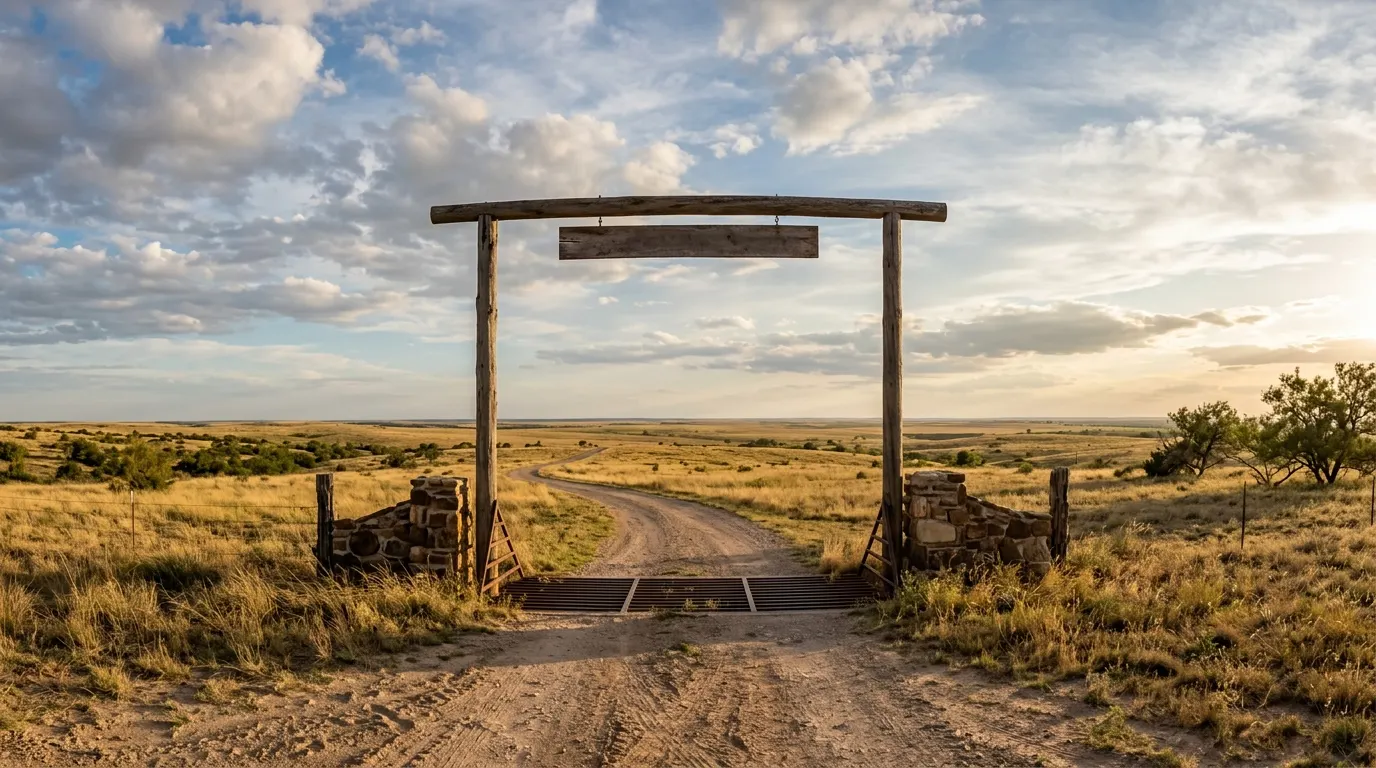
Cattle guards for Texas ranches
Texas has more beef-cow operations than any other state — roughly three times the runner-up — and it's the one state where the law hands you a concrete reason to put a cattle guard in. A properly authorized guard on a county road isn't just a convenience — the Agriculture Code says your cattle on that road aren't "running at large." Here's the statute in plain English, what the county expects, and what a guard delivered to a Texas gate actually costs.
What does Texas law say about cattle guards?
Here's the rule, straight from the Agriculture Code:
Under Tex. Agric. Code §143.003, cattle on a county road are not "running at large" if the road (1) separates tracts under common ownership or lease and (2) contains a cattle guard built as authorized under §251.009, Transportation Code.
In plain English: if your land sits on both sides of a county road — owned or leased — and that road has a cattle guard that was put in the right way, the law says your cattle on that stretch of road are not loose stock. That phrase, "running at large," is the hinge Texas livestock liability turns on. A compliant guard takes your cattle out of that category on that road.
That's why we tell Texas buyers a cattle guard isn't a discretionary purchase. It's a liability shield with a part number.
The honest caveat: we sell steel, we don't practice law. Stock laws in Texas run county by county, and both conditions of §143.003 have to hold for the safe harbor to apply. This page is orientation, not legal advice — read the statute and confirm your situation with your county or your attorney.
Who approves a cattle guard on a county road?
Notice the statute's second condition: the guard has to be "built as authorized under §251.009, Transportation Code." That section is where the county comes in. A guard in a county road isn't a unilateral move — authorization runs through the county, which in practice means the commissioners court signs off before the guard goes in.
So the sequence matters. Talk to your county first, get the authorization squared away, then order steel. If the county has questions about the guard itself — dimensions, load rating, construction — call us at (800) 555-0143 and we'll put spec sheets in your hands the same day. A real person answers quote requests within 4 business hours.
On your own property, away from the county right-of-way, none of this applies. Your driveway, your call.
Why HS20 is the rating that satisfies the county
When a county weighs in on a crossing, the expectation is a road-rated guard. HS20 — 16 tons per axle, 32,000 pounds — is the de-facto standard for county and public-road use, and it's what we lead with. For scale: a loaded one-ton dually puts under 4 tons on an axle. An HS20 guard carries four times that, per axle, all day.
Our workhorse for Texas entrances is the Powder River 12-foot guard — the 12' × 8' HS20 runs $4,899. If trucks and stock trailers swing into your entrance off a caliche road, the 14-foot span buys the extra room. Running loaded trucks, feed rigs, or heavy equipment over the crossing? U-54 (25 tons/axle) and U-80 (30 tons/axle) ratings are in the line too — the full breakdown is in our load ratings guide.
Every guard is Powder River steel, powder-coat green standard, with safety yellow available on the H-20 line. Wing panels that close the gap between guard ends and your fence run $569 a pair and ship with the guard at no added freight.
What does freight to Texas cost?
Our guards ship LTL from Utah on lanes we've priced with real carrier quotes. Delivered to a Texas ranch — farm delivery and handling included — a single guard typically lands between about $900 for an 8-foot span and $1,225 for a 14-footer, depending on your ZIP. That's mid-pack for the lower 48, where single-guard freight runs $500–$1,300 before the farm-delivery accessorial.
Farm and ranch delivery — the accessorial carriers charge for any stop without a loading dock — is priced in by default, because that's where cattle guards go. And the number you see at checkout is final: freight is passed through at carrier cost plus handling, charged once, with your guard. No callback, no second charge on your card. How delivery works, in full.
Putting in more than one crossing? A second guard on the same shipment adds roughly a third of the first guard's freight — the truck is already headed your way. For multi-entrance ranches and county buyers, that math adds up fast.
What you handle, what we handle
We deliver. We do not install. You'll need a tractor, loader, or forklift on site — the carrier cannot unload 1,000 to 1,800 pounds of welded steel. We send free foundation drawings with every order; you source concrete locally and any competent excavator can set the guard in a day's work. For county-road installs, have your county's requirements and an engineer's eyes on the foundation — that's part of getting it "built as authorized."
Guards are built to order and typically ship in 1–2 weeks. Transit after pickup is quick on Texas lanes — the carrier calls before delivery to set a window.
Texas questions, straight answers
Does a cattle guard make my cattle legal on a county road?
Texas Agriculture Code §143.003 says cattle on a county road are not "running at large" when the road separates tracts under common ownership or lease and contains a cattle guard built as authorized under §251.009 of the Transportation Code. Both conditions have to hold, and county stock laws vary — read the statute yourself and confirm your situation with the county. This is orientation, not legal advice.
Do I need county approval for a guard on my own driveway?
On your own land, off the county right-of-way, the guard is your call. The moment the guard sits in a county road, authorization runs through the county under §251.009, Transportation Code — which means talking to your commissioners court before you dig, not after. One phone call to the county saves a world of grief.
What rating do Texas counties expect?
HS20 — 16 tons per axle, 32,000 pounds — is the de-facto standard for county and public-road work. Lighter H-15 guards are fine for many private drives, but if a county official or an engineer is ever going to look at your crossing, HS20 is the answer that ends the conversation.
What does shipping to Texas actually cost?
For a single guard delivered to a Texas ranch — farm delivery and handling included — plan on roughly $900 for an 8-foot span up to about $1,225 for a 14-footer, ZIP depending. You see the exact number for your ZIP before checkout, and it's charged once. No freight call two days later.
How long until it's at my gate?
Guards are built to order and typically ship in 1–2 weeks. Transit after pickup runs 1–2 business days regionally and up to 4–7 cross-country. The carrier calls ahead to set a delivery window.
Can you install it?
No. We deliver. We do not install. We'll send free foundation drawings with your order, and any local excavator with a concrete crew can do the rest. Have a tractor, loader, or forklift on site for delivery — the driver cannot unload it.
Price a guard to your Texas gate
Every size and rating, with the delivered price to your ZIP before you pay a dime. Or call (800) 555-0143 — two minutes on the phone beats an hour of guessing.
See guards & delivered prices Request a quote