What is a cattle guard?
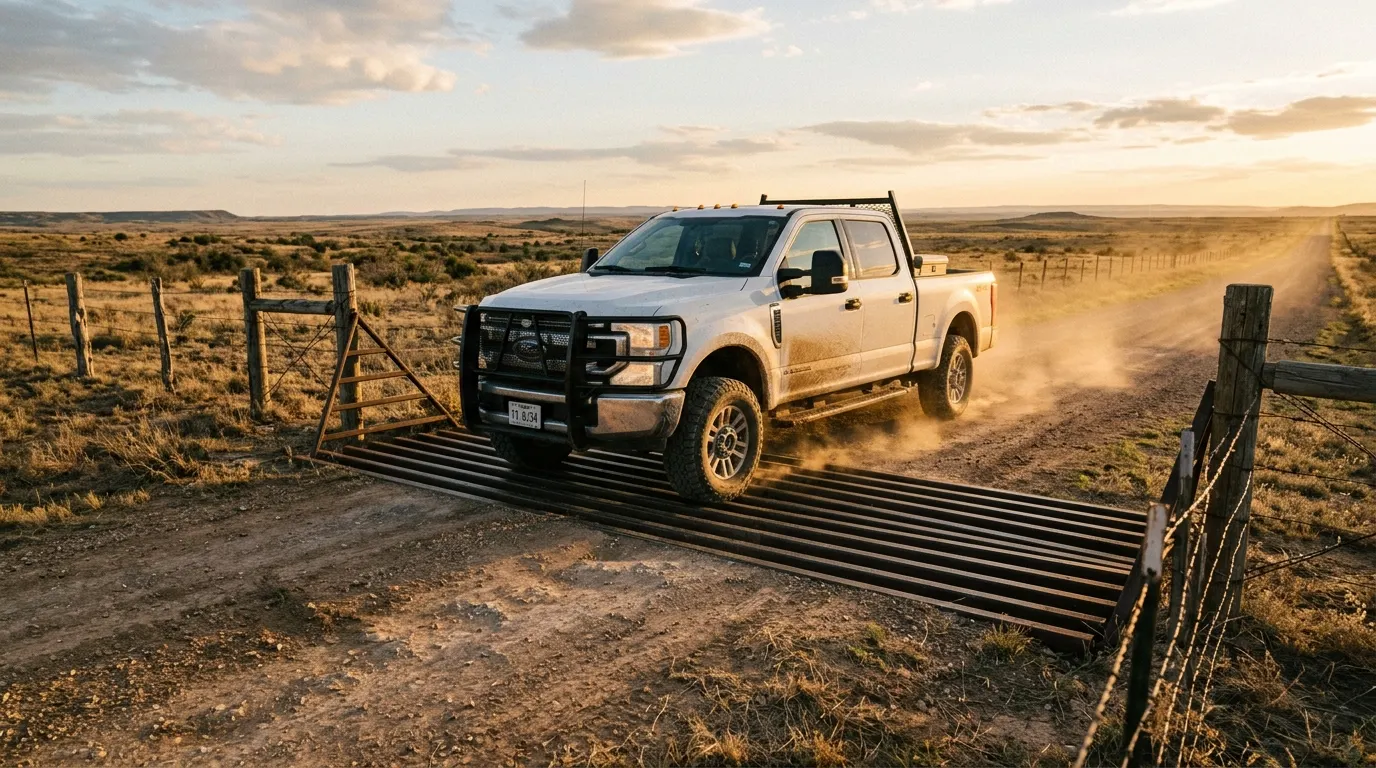
A cattle guard is a grid of steel rails set over a shallow pit in a road or gateway. Vehicles drive straight across it; cattle and other livestock will not, because they refuse to step onto uncertain footing over open gaps. It does the job of a gate without anyone stopping to open one.
One quick clarification before we go further: if you're looking for a brush guard or grille guard for the front of your truck, that's a different product entirely — this page is about the kind you drive over.
How does a cattle guard work?
A cattle guard works on footing, not force. Looking down at the grid, an animal sees gaps it can't judge and a walking surface its hooves can't trust, so it stops at the edge and turns back. The deterrent is refusal — the animal declines to make the crossing at all.
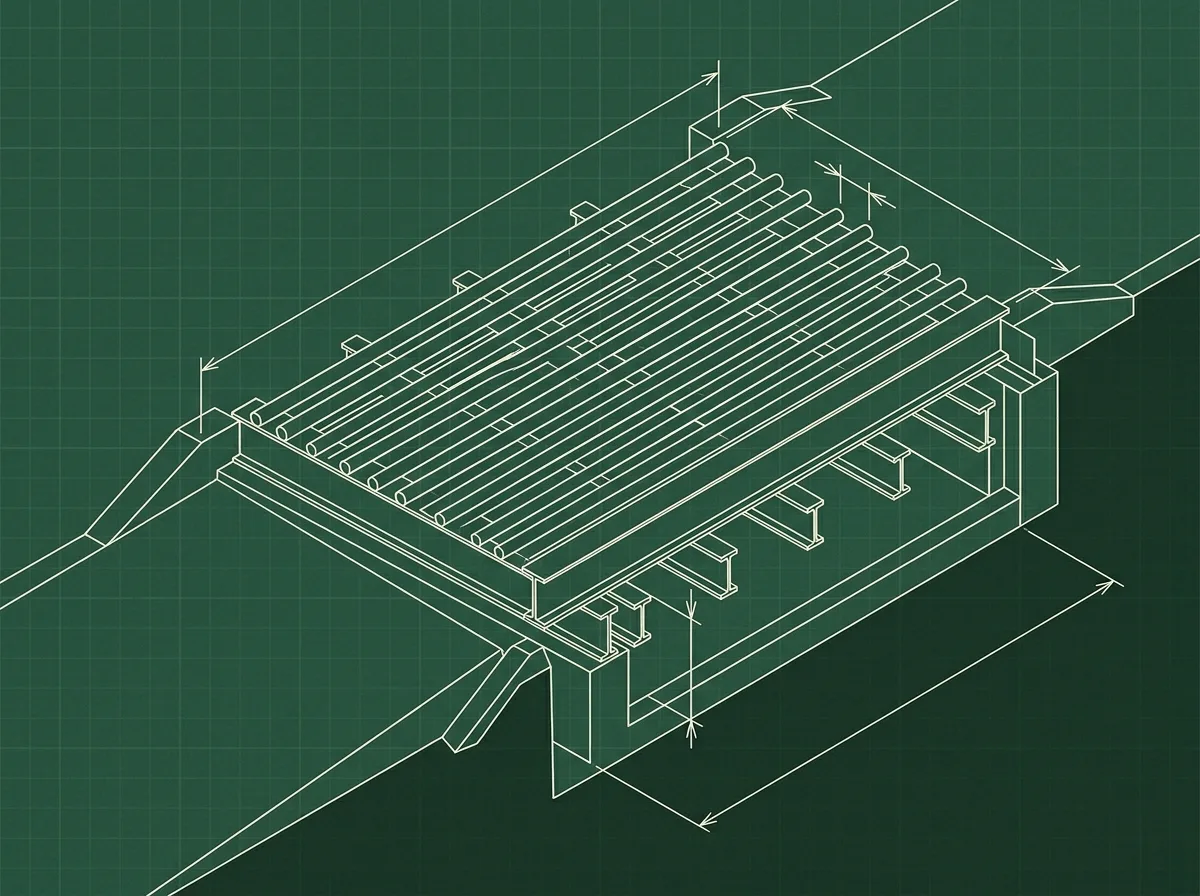
Structurally, it's simple: parallel steel top rails welded across I-beam runners, the whole assembly resting on footings over a shallow vault. The vault keeps daylight visible under the rails and gives mud, snow, and manure somewhere to go instead of packing the gaps solid.
For a vehicle, the same grid is just a short steel bridge. Rated guards carry far more than any pickup puts down — more on ratings below — so the truck rumbles over at speed while the fence line stays effectively closed to stock, around the clock, with no moving parts.
The vault does need occasional attention: on a dusty lane it slowly collects silt, and a vault filled to the rails is no vault at all. Grade the approach so water sheds away rather than washing in, and shovel it out when it needs it. Clean-out designs, built to make that chore easier, are offered on some product lines for exactly this reason.
Do cattle guards hurt cows?
A properly built cattle guard is designed so the animal never sets foot on it. Cattle read the grid as unsafe footing and stop before the first rail; the working principle is hesitation, not pain. Day to day, a guard is a passive barrier the herd simply ignores.
The honest caveat: an animal forced onto a guard — spooked, chased, or crowded through a pinch point — can get a leg down between rails, and that can end badly. So don't drive stock across one. Move the herd through a gate hung beside the guard, which is how most working ranches lay out the entrance anyway.
Should you put in a cattle guard or a gate?
A gate is cheaper on day one. A cattle guard wins every day after that, because nobody has to stop, climb out, swing it open, pull through, and climb out again to close it — in your truck, in the dark, in February, twice.
The gate's real failure mode isn't the hardware — it's people. A gate left open by a delivery driver, a hunter, or a kid in a hurry is an open fence. A cattle guard cannot be left open. That's the whole argument in one sentence.
Gates still earn their place: you need one anywhere you'll actually move stock through, since animals won't cross the grid. The standard setup is a guard in the roadway with a swing gate beside it in the fence line. We sell the guard; the gate you'll source locally like any fence hardware.
What is a cattle grid?
A cattle grid is the same device as a cattle guard. "Cattle grid" is the standard term in the UK, Australia, and New Zealand; American ranchers say "cattle guard." Same steel rails, same pit, same refusal at the edge — see our cattle guard vs. cattle grid page for the terminology rundown.
One more name collision worth knowing: on railroads, "cattle guard" historically also meant the angled pilot on the nose of a locomotive — the cowcatcher. Different machine entirely. If you're searching for the thing built into a ranch road, you're in the right place.
What size is a typical cattle guard?
Two numbers describe a cattle guard. Width is the span across the road — the number you buy. Depth runs in the direction of travel, and it's the distance an animal faces if it considers jumping. Standard road spans are 8, 10, 12, and 14 feet, in depths of 7'5" or 8 feet.
| Road span (width) | Approx. weight | Where it fits |
|---|---|---|
| 8 ft | ~1,000 lb | Tight single-lane drives |
| 10 ft | ~1,270 lb | Comfortable single lane |
| 12 ft | ~1,530 lb | The county single-lane standard |
| 14 ft | ~1,800 lb | Wide gates and trailer traffic |
A note on that depth figure, because it trips up buyers comparing listings: you'll sometimes see the shallower depth written as "7.5 ft." That's a mislabel. The dimension is 7'5" — seven feet five inches, not seven and a half feet. When you're matching a guard to an existing vault or a poured foundation, three inches is the difference between drops-in and doesn't.
The 12-foot guard is the best seller for a reason: it's what county road departments spec for single-lane crossings and it clears any pickup with margin. Wide gate openings and regular stock-trailer traffic call for the 14-foot span. Spans of 16 to 24 feet and double-lane configurations exist too — those quote by phone at (800) 555-0143.
Finish is powder-coat green as the standard, with safety yellow available on the HS20 line for entrances where you want the crossing visible from a distance.
How much weight can a cattle guard hold?
Steel cattle guards carry highway-style load ratings, stated per axle. H-15 is rated 12 tons per axle. HS20 — also written H-20 — is rated 16 tons per axle, or 32,000 pounds, and is the de-facto standard for residential drives and county roads. U-54 and U-80 carry 25 and 30 tons per axle for crossings that see genuinely heavy loads.
For scale: a loaded one-ton dually pickup puts under 4 tons on an axle. A full HS20 guard is rated four times that. Our load ratings guide matches each rating to real vehicles, and the cost guide puts the rating steps in plain dollars.
Two spec-sheet notes worth having in your pocket. First, there is no "H-10" cattle guard in this market — the floor is H-15, so a listing claiming less is describing something other than a rated guard. Second, the heavy U-54 and U-80 ratings are built only in the 8-foot depth, so a heavy-rated guard also commits you to the deeper vault.
When do cattle guards fail?
Sold honestly, a cattle guard is a strong deterrent, not a force field. Three failure modes are worth knowing before you buy from anyone, including us.
Determined jumpers. The occasional individual animal learns to leap a guard or pick its way across the rails. That's the reason depth matters — 7'5" to 8 feet in the direction of travel is a long jump to attempt — and why a guard protects a fence line rather than replacing good fencing around it.
Skirting the ends. Stock will walk around a guard where it meets the fence if there's a gap to squeeze through. Wing panels close that gap by tying the guard ends into the fence — our wings guide covers when you need them and when a pinch-point gate does the same job.
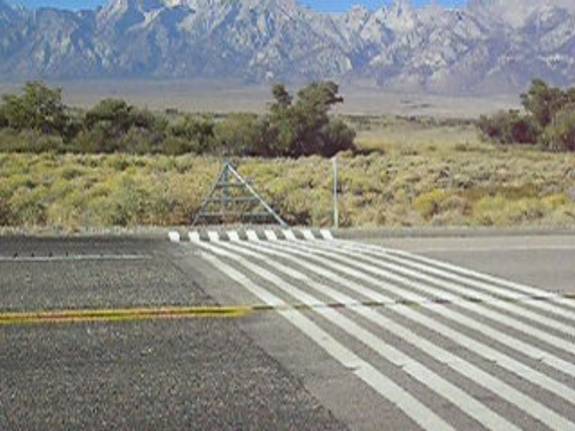
Painted stripes. Stripes painted across pavement to imitate a grid rely entirely on the illusion holding. There is no bad footing behind the paint, so the arrangement only works until one animal tests it — and once one crosses, others follow. We wouldn't trust paint as a property line, and we say that as people with steel to sell and no paint.
Where did cattle guards come from?
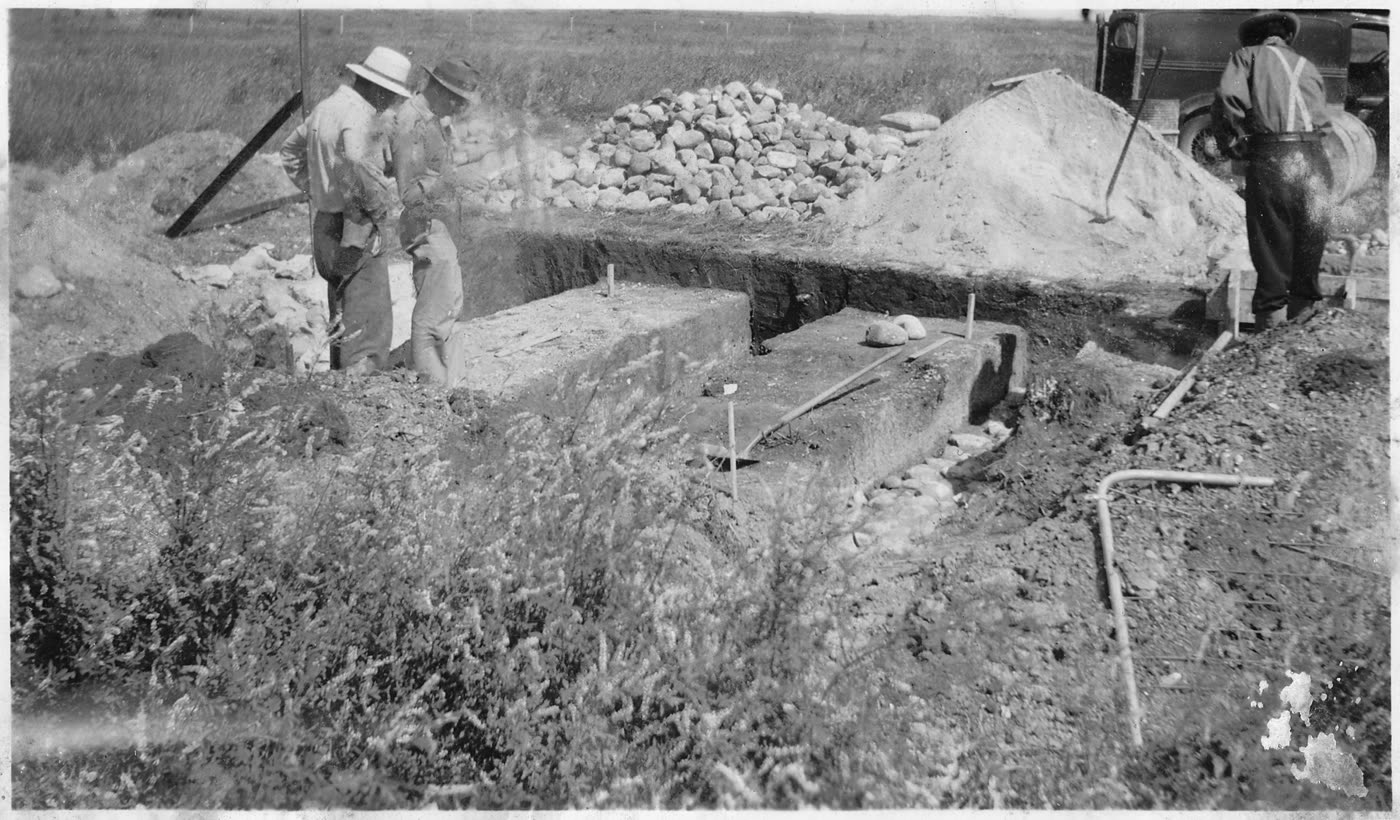
The road version spread across the American West as trucks replaced horses on ranch lanes. A wire gate you could lean down and flip open from the saddle became a stop-and-climb-out ritual in a vehicle, and ranchers wanted the fence closed and the road open at the same time. A steel grid over a pit did both, and the design has barely changed since — it hasn't needed to.
When do you actually need one?
The math is traffic. A gate you open twice a month is fine as a gate. An entrance you cross daily — the drive off the county road, the lane between home place and hay ground, the front entrance every delivery and school bus uses — is where a guard pays for itself in never stopping.
Ranches with more than one entrance should think in pairs. A second guard on the same shipment adds roughly a third of the first one's freight, because the truck is already coming — which is why multi-entrance places and county buyers order two or three at a time. The full plain-language story on shipping half-ton steel is on our how delivery works page.
If that's your entrance, every size and rating we build is listed with a real delivered price on our cattle guards for sale page — the line runs $3,299 to $6,599, built to order and typically shipping in 1–2 weeks. We deliver. We do not install — setting the guard is local work, and our installation guide plus free foundation drawings walk your excavator through it.
Cattle guard questions, answered straight
How much does a cattle guard cost?
Our Powder River steel guards run $3,299 for an 8' H-15 up to $6,599 for a 14' U-80. The most popular pick, a 12' x 8' HS20, is $4,899. Freight adds $500–$1,300 anywhere in the lower 48 — and here you see that exact number before you pay, not on a second charge afterward.
How heavy is a cattle guard?
Roughly 1,000 lb for an 8-foot span up to about 1,800 lb for a 14-footer. That's why you'll need a tractor, loader, or forklift on site when it arrives — the delivery carrier cannot unload it.
Does a cattle guard need a foundation?
Yes. The grid sits on footings over a shallow vault, and concrete poured locally is the usual answer. We share foundation drawings free with any order and recommend sourcing the concrete in your own county — shipping precast foundations costs more than they're worth.
Do you install cattle guards?
No. We deliver. We do not install. Setting a guard is local excavation work — a backhoe or a tractor, a level base, and an afternoon. Our installation guide covers excavation depth, base prep, and drainage, and the foundation drawings come free.
How long does it take to get a cattle guard?
Ours are built to order and typically ship in 1–2 weeks. Transit after pickup runs 1–2 business days regionally and up to 4–7 days cross-country. The carrier calls ahead to set a delivery window.
What are cattle guard wings for?
Wings close the gap between the ends of the guard and your fence line so stock can't skirt around the grid. They ship with the guard on the same truck, so they add no freight.
Does a cattle guard have to have a pit under it?
The standard design sits over a shallow vault — that's what keeps the gaps reading as gaps and gives debris somewhere to go. Set-in-place designs that rest on grade do exist for situations where digging isn't practical; we quote those by phone at (800) 555-0143.
See every size with its delivered price
Shop cattle guardsNot sure on span or rating? Call (800) 555-0143 — a real person, two minutes, no runaround.