How to install a cattle guard — from a company that won't
Straight talk first: we deliver. We do not install. Not sometimes, not for a fee, and we'll never quote supply-and-install as one price. But the guard only works as well as the hole it sits in, so here's the whole job — what to dig, what to pour, what kills guards early, and what setting day looks like with a tractor. Hand this page and our free foundation drawings to your excavator and you're most of the way there.
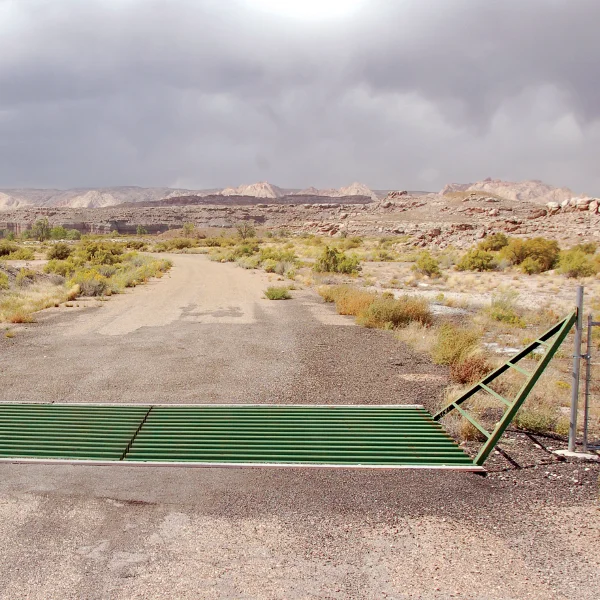
Who actually installs it, then?
Any local dirt-work contractor. This is a dig, a form-and-pour, and a lift — ordinary work for an excavation outfit or a fencing contractor who pours footings. Every guard we sell ships with free foundation drawings dimensioned to your exact unit, so nobody on site has to guess. Concrete comes from your nearest ready-mix plant; our foundations guide explains why we don't ship precast.
One scheduling note: guards are built to order and typically ship in 1–2 weeks. That's your window to dig and pour, so the steel arrives to a cured foundation instead of a pile of dirt.
How big does the hole need to be?
Start with the guard's two numbers. Width is the span across the road — 8', 10', 12', or 14'. Depth is the direction of travel — 7'5" or 8'. The pit is that footprint plus working room on each side to set forms and pour the two bearing footings the guard rests on, one under each edge where vehicles enter and leave. The drawings dimension all of it for the unit you bought, footings included.
Pit depth matters more than most people expect. The open air under the rails is the whole trick — uncertain footing over a visible gap is what turns a cow around. A shallow pit silts up fast and gives that advantage away. Dig to the drawings, not to whenever the digging gets old.
Why do cattle guards fail?
Two ways, and they travel together: standing water and silt. Runoff finds the lowest point on your road, and the vault is now the lowest point on your road. Water sits, every rain drops another layer of fines, and in a few seasons the pit has shallowed into a floor. A grid over solid ground is just a rough bridge — stock will test it, then cross it.
The fix is boring and permanent: slope the vault floor to one side, give that side a drain out to daylight or a gravel sump, and keep the approaches graded so the road sheds water away from the guard instead of into it. Plan on shoveling the pit occasionally no matter what. If you'd rather make that chore easier, our H-20 line offers a clean-out design for a flat $279.
Vault or on-grade — which do you want?
A vaulted install — grid over a dug pit on poured footings — is the permanent answer for a ranch entrance. It costs you an excavator day and some concrete, and it keeps real depth under the rails with somewhere for water to go.
On-grade means the guard sits at surface level — on shallow footings or timber cribbing — with the road ramped up to it. It's faster and cheaper, and for interior crossings or a temporary setup it can be the right call. The tradeoff is honest: less air under the rails, so it silts toward useless sooner and asks for more maintenance. For the front entrance you drive twice a day, dig the vault.
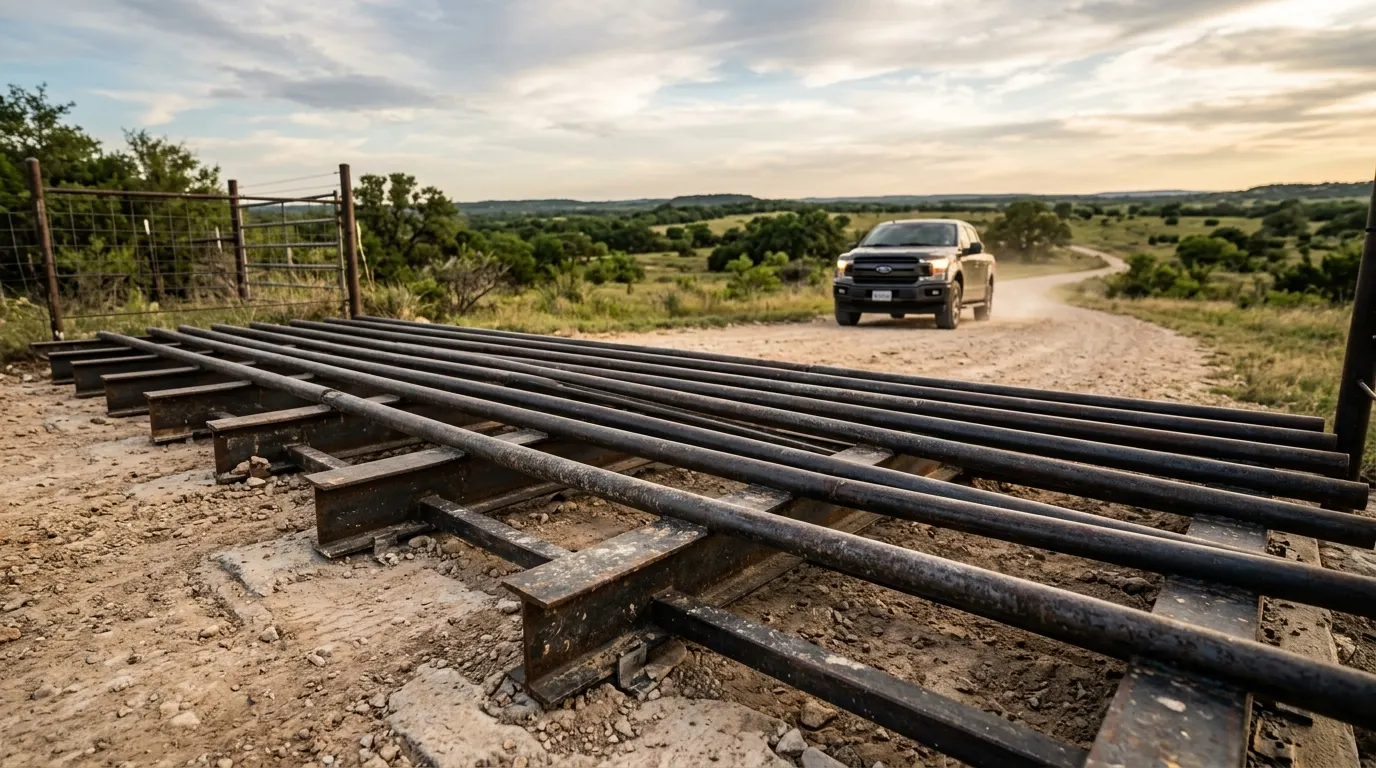
What happens on setting day?
Have the tractor there before the freight truck. The carrier cannot unload a cattle guard, and the driver won't help you improvise — a 12' guard runs about 1,530 lb, a 14' about 1,800. Pallet forks on the loader, off the truck, staged on grade next to the hole.
Then the sequence is short. Footings cured and stripped, anchor hardware laid out per the drawings. Forks under the frame, walk the guard over the pit, set one bearing edge, lower the other square. Check three things before you unhook: the rails sit flush with the finished road surface, the guard is level across the span, and both edges have full bearing — shim per the drawings rather than let a corner rock. A guard that rocks under traffic hammers itself and its footings apart. Anchor it, backfill, and compact the approaches so tires roll on instead of slamming the leading edge. Keep the backfill out of the vault.
How do the wings go on?
A guard ends where it ends, and cattle will walk the fence line looking for the gap between the guard's edge and your fence post. Wings close it: they bolt to the ends of the guard, angle back to the fence line, and give you a solid point to stretch wire to. Ours run $569 a pair and ship with the guard at no added freight — bolt them on before you backfill and the job's done in one go.
What's different on a county road?
Everything starts with a phone call to the county road department — before you order, not after. Counties commonly have their own spec for span, rating, and foundation detail, and many want an engineer's stamp and commissioner sign-off. The rating question usually answers itself: HS20 — 16 tons per axle, 32,000 lb — is the de-facto standard for county and public-road work. Our load ratings guide covers what the classes mean and what real vehicles weigh.
Everything on this page is general practice, not engineering advice. Where a public road, a permit, or an inspector is involved, the county's spec and your engineer outrank us — and we'll cheerfully build to whatever they stamp.
Budgeting the whole project? The guard and freight are the known numbers — our cost guide publishes both. Concrete and the excavator day are local money, so price those at home.
Installation questions
Do you install cattle guards?
No. We deliver. We do not install — and we never quote supply-and-install as one price. Every order includes free foundation drawings, and any competent excavator or fencing contractor can take it from there.
Who should I hire to set a cattle guard?
A local excavation or dirt-work contractor is the usual answer; fencing contractors who pour footings do it too. Hand them the foundation drawings that come with the guard and source concrete from your local ready-mix plant. There's no specialty trade to hunt down.
Why do cattle guards stop working?
Standing water and silt. A vault with no drain fills with runoff, the runoff drops its silt, and the pit shallows up until the grid is sitting over solid ground. At that point it's a bridge, and cattle figure that out. Slope the vault floor, give water a way out, and shovel the pit when it needs it.
Do I need an engineer to install a cattle guard?
On a private drive, no — follow the drawings and your local codes. On a county or public road, expect the county to have its own spec and to want an engineer involved. HS20 — 16 tons per axle — is the de-facto standard rating for that work. Call the road department before you order anything.
How do I get the guard off the delivery truck?
You'll need a tractor, loader, or forklift on site — the carrier cannot unload it. Guards run from about 1,000 lb for an 8-foot span to about 1,800 lb for a 14-foot, so pallet forks on a loader tractor are the usual tool.
Buy the guard. The drawings ride free.
See guards & delivered pricesFree foundation drawings with any order. Questions before you dig? Call (800) 555-0143 — a real person, and we've heard every version of "my excavator wants to know…"