Cattle guards for driveways
The driveway is where cattle guards earn their keep: the one entrance you cross every single day, in the truck, in the dark, in the rain — the one gate nobody wants to climb out and open twice. Here's how to size a guard for a residential drive, what it costs delivered, and the honest answer on cars, ratings, and permits.
Why a driveway cattle guard beats a driveway gate
A gate on a working entrance charges you in time, every crossing, forever — and it charges whoever forgets to close it. A cattle guard for a driveway costs once and then gets out of the way: the fence line stays closed to stock around the clock, and you never stop the truck. The usual setup keeps a small swing gate beside the guard for moving animals and equipment through; our guard-plus-gate layout guide covers that arrangement.
What size fits a residential drive?
Buy the span that covers your travel surface, not an inch less. Most single-lane drives take an 8-foot or 10-foot guard. If a stock trailer, RV, or delivery box truck ever swings into your entrance — especially off a road at an angle — the 12-foot span is the buy-once answer; it's what counties spec for single-lane public crossings. The full logic, with measurements, is in the sizing guide.
Cars and cattle guards: the flush-install answer
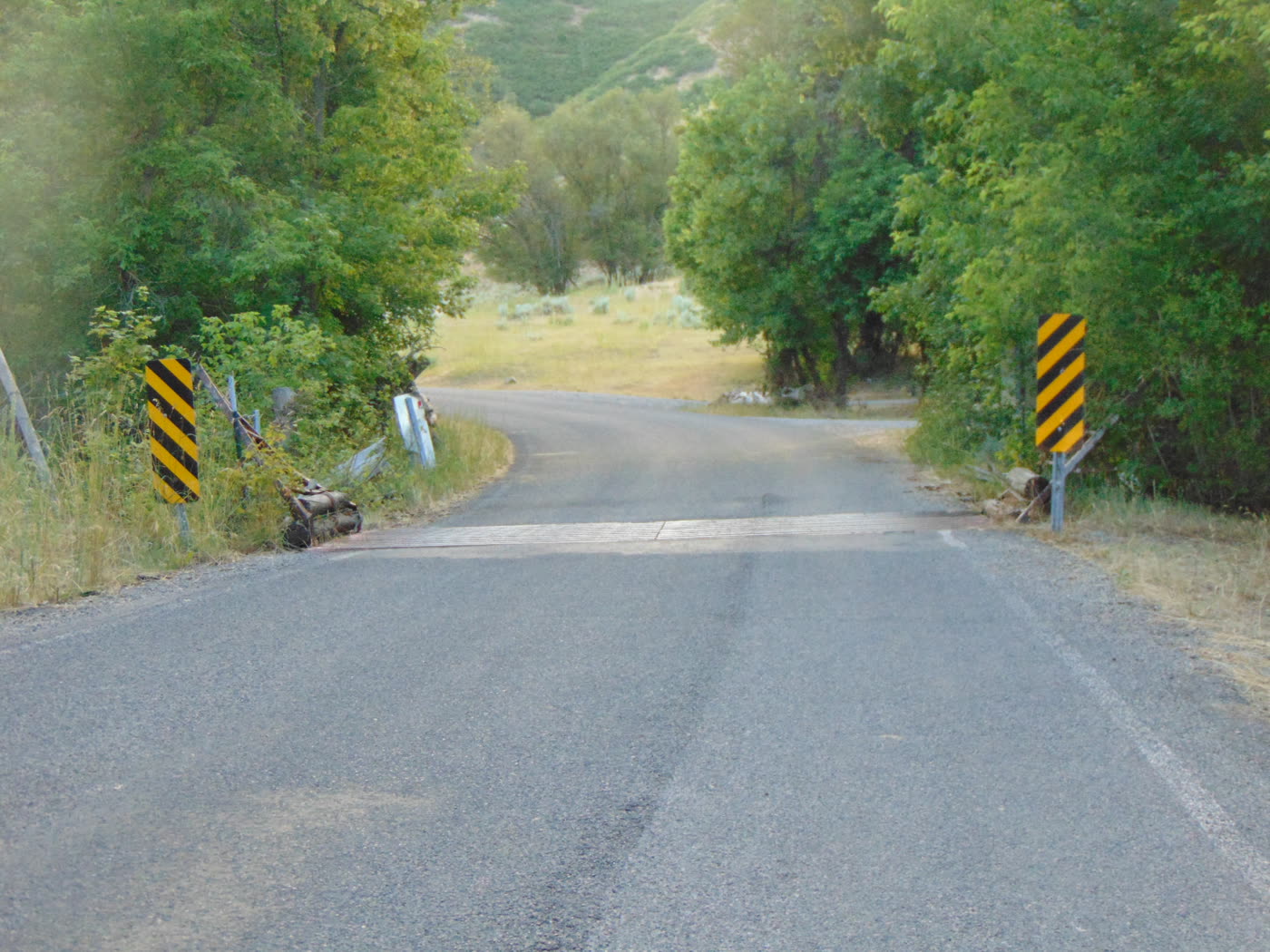
A properly set guard is flush with the road — rails at grade, vault below. Cars, including low ones, cross at driveway speed with nothing but the rumble. The horror stories you read about scraping all trace back to installation: a guard set proud of the road, or an approach graded like a ramp. Set it to the drawings and the guard is the smoothest steel on your drive.
H-15 or HS20 for a home driveway?
H-15 — 12 tons per axle — covers every car, pickup, and tandem-axle trailer a household produces, and it's the least expensive rated guard we sell at $3,299. The case for HS20 is the vehicles you don't own: fire apparatus, a moving van, the concrete truck for your own foundation pour. If any of those will ever cross, the few hundred dollars to HS20 is cheap certainty. Below H-15, nothing legitimate exists — a guard with no rating is a guess with your truck on top of it.
What a driveway guard costs, delivered
Entry point: the 8' × 7'5" H-15 at $3,299. The most popular residential pick, the 12' × 8' HS20, is $4,899. Freight to a home or ranch on a regional lane typically lands around $800–$1,000 all-in — farm/residential delivery included — and your exact ZIP's number shows before checkout and is charged once. No second freight charge, ever. The cost guide walks three fully worked delivered examples, and the concrete is a local pour from free foundation drawings.
The fine print your county cares about
On private land the guard is your business, but the first twenty feet of most driveways — the apron where you meet the public road — is often county right-of-way. Call the county before you dig there, and ask about culvert and sight-line rules while you have them. HOA covenants, where they exist, are worth a look too. Five minutes of phone calls beats re-pouring a foundation.
Driveway cattle guard questions
What size cattle guard do I need for a driveway?
Match the span to your travel surface. Most single-lane residential drives take an 8' or 10' guard; if trailers, RVs, or delivery trucks swing in, the 12' is the comfortable answer and matches what counties spec for single-lane crossings. Depth is 7'5" or 8' — the 8' depth is the stronger deterrent for a few hundred dollars more.
Will a regular car drive over a cattle guard?
Yes. An installed guard sits flush with the road surface, so a sedan crosses it the same way it crosses a speed bump's opposite — smoothly, with a rumble. What low cars actually dislike is a badly graded approach, not the guard. Keep the approach flat per the foundation drawings and any street-legal vehicle crosses fine.
Is H-15 enough for a residential driveway?
For cars, pickups, and the occasional trailer — yes, with room to spare. H-15 is rated 12 tons per axle and a loaded one-ton dually is under 4. Step up to HS20 (16 tons/axle) if a school bus, fire truck, moving van, or concrete truck will ever use the drive. The step costs a few hundred dollars once.
How much does a driveway cattle guard cost, delivered?
Our line starts at $3,299 for the 8' × 7'5" H-15. Freight to a home or ranch typically runs $800–$1,000 on regional lanes with farm/residential delivery included — you'll see your exact ZIP's number before checkout, charged once, no second charge. Foundation concrete is poured locally from free drawings we include.
Do I need a permit for a cattle guard on a private driveway?
On your own land, off the public right-of-way, it's generally your call — but check your county and any HOA before you dig, especially where the drive meets the public road. The entrance apron is often county right-of-way, and that portion needs their sign-off.
Do you install driveway cattle guards?
No. We deliver. We do not install. Setting a guard is a day of local excavation and concrete work — our installation guide and free foundation drawings walk any local operator through it, and you'll need a tractor, loader, or forklift on site for delivery.
Price one to your driveway
Every size with a real delivered price to your ZIP — before you pay, charged once. Or call (800) 555-0143 and size it with a person in two minutes.
See guards & delivered prices