Steel cattle guards: what the steel is doing, and what it costs
Every guard we sell is welded steel — Powder River, 8' to 14' spans, rated H-15 through U-80, $3,299 to $6,599 with every price published. This page covers why steel beat pipe and concrete, what's actually under the rails, what the ratings mean in steel terms, and which guard fits your road. We deliver. We do not install.
Why steel instead of pipe or precast concrete?
A cattle guard has one structural job: carry an axle across a hole in your road, thousands of times, without flexing enough to crack a weld. Three constructions compete for that job, and they are not close.
Fabricated steel is built like a short bridge — rails across the top, beam runners underneath carrying the load down into the foundation. It arrives as one welded, rated unit at 1,000 to 1,800 pounds, which is exactly the weight range LTL freight handles well. Rated steel is what counties spec and what this whole page is about.
Welded pipe guards — round pipe rails, often shop-built — cost less, and for a rarely-used two-track they can serve. The problem is the number you don't get: if a guard carries no certified load rating, you don't know what it holds, and you find out when a loaded stock trailer or a propane truck finds out for you. An unknown rating is an unknown liability sitting in your road.
Precast concrete is durable and it ships terribly. Weight is the tax: the precast foundations alone for a cattle guard run 2,000–3,500 pounds, heavy enough to force flatbed trucking instead of ordinary LTL freight — a full concrete guard only compounds it. Concrete makes sense poured locally, under a steel guard, which is why we ship the steel and hand you free foundation drawings instead of shipping concrete across the country.
What's actually inside a rated steel guard?
Strip the paint off and a steel cattle guard is two systems welded into one unit.
The top is the rail deck: parallel rails running across the road span, spaced so a tire rolls over them smoothly but a hoof can't find flat footing between them. That gap is the whole product — cattle refuse uncertain footing over a void, so the deck works on the animal's judgment, not on force.
Underneath are the beam runners — the structural members that take each axle hit from the rails and spread it into the foundation. The runners are where the load rating lives, and they're where the weight is: figure roughly 1,000 lb in an 8' guard and 1,800 lb in a 14'. A guard's shipping weight is a spec you can verify, and it tells you more about what you're buying than any adjective on a product page.
Two dimensions describe the deck. Width is the span across your road — the number you buy. Depth is the distance in the direction of travel — the gap the animal would have to cross — and comes in 7'5" or 8'. On the HS20 line you can add a clean-out design for a flat $279, which lets you clear silt and gravel out of the vault without pulling the guard.
What do H-15, HS20, U-54, and U-80 mean in steel terms?
The rating is the guard's certified axle load. More rating means more steel section in the load path — heavier members under the same-looking deck. In numbers:
| Rating | Per axle | In pounds | What that covers |
|---|---|---|---|
| H-15 | 12 tons | 24,000 lb | Cars, pickups, light residential traffic |
| HS20 | 16 tons | 32,000 lb | The residential and county standard — loaded trucks, trailers, daily ranch traffic |
| U-54 | 25 tons | 50,000 lb | Grain trucks, loaded stock trailers, heavy equipment |
| U-80 | 30 tons | 60,000 lb | Heavy commercial and oilfield traffic — the heaviest rating made |
For scale: a loaded one-ton dually puts under 4 tons on an axle — even H-15 carries triple that. HS20 is the de-facto standard for county and public-road work, and it's what we tell most buyers to get. The U-ratings are built only in the 8'-deep bed. And if you see "H-10" advertised somewhere, be skeptical — that rating doesn't exist in this market; the floor is H-15. The full breakdown, with the price difference each step costs in plain dollars, is in our load ratings guide.
Why powder coat and not paint?
Powder coat is a finish baked onto the steel as one continuous coating over the whole welded assembly — it's the category-standard finish for a reason, and green is the standard color. The HS20 line also comes in safety yellow, priced per variant, for crossings where you want the guard seen before it's felt. If your site genuinely eats steel — heavy salt, standing water — hot-dip galvanizing exists as a special order: it adds 30–45% and a long lead time, so we quote it by phone at (800) 555-0143 rather than listing it.
Which steel guard fits your road?
Four spans, all built to order and typically shipping in 1–2 weeks. Prices below are the HS20 in the 8'-deep bed, green — the configuration most ranches and counties buy. Every variant from H-15 to U-80 is priced on the full price matrix.
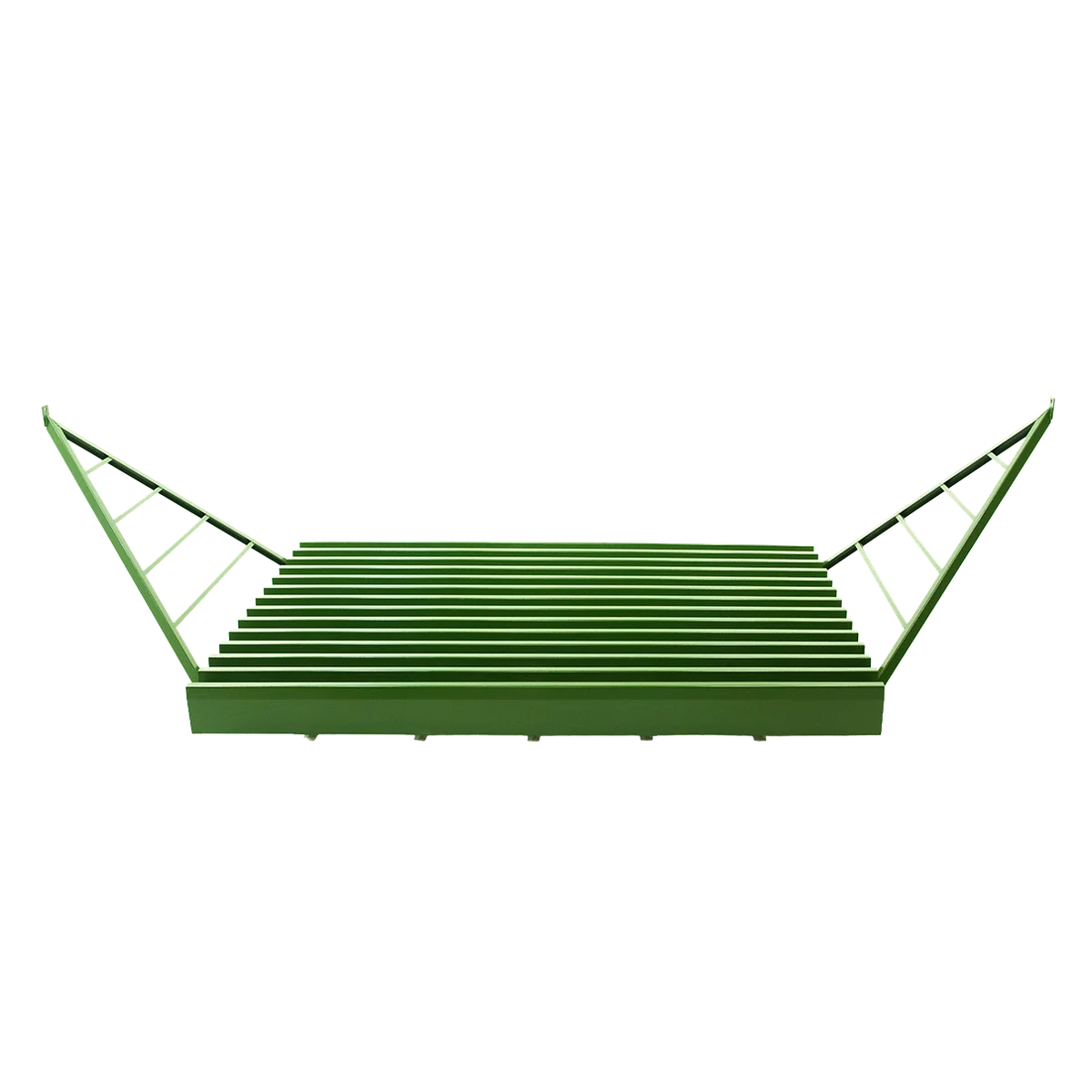
Powder River 8' steel guard
+ freight to your ZIP — shown before checkout
View & pricePowder River 10' steel guard
+ freight to your ZIP — shown before checkout
View & pricePowder River 12' steel guard
+ freight to your ZIP — shown before checkout
View & pricePowder River 14' steel guard
+ freight to your ZIP — shown before checkout
View & pricePowder River factory photo — 8'×12' HS20 with optional wings shown.
The 12-footer matches county single-lane spec and is the one most people should buy; the 14-footer earns its price wherever trailers swing through the gate at an angle. Need 16'–24' spans, double lane, or galvanized? Those quote by phone in one business day.
What does it take to get one to your gate?
Steel this heavy ships LTL freight — typically $500 to $1,300 anywhere in the lower 48, and we quote it to your ZIP before checkout, charged once with the guard. No freight callback, no second charge. You'll need a tractor, loader, or forklift on site — the carrier cannot unload it. Wing panels, if you want them, are $569 a pair and ride on the same shipment for zero added freight. The whole delivery story, including damage claims, is on our freight page; what the total really adds up to, foundation and all, is in the cost guide.
Steel cattle guard questions
Do steel cattle guards rust?
The standard finish is powder coat — a baked-on coating applied over the whole welded assembly, which is why it's the category norm instead of brush paint. For genuinely corrosive settings, hot-dip galvanizing is available on special order: it adds 30–45% to the price and a long lead time, so we quote it by phone at (800) 555-0143.
How heavy is a steel cattle guard?
Roughly 1,000 lb for an 8' span, 1,270 lb at 10', 1,530 lb at 12', and 1,800 lb at 14'. That weight is load-bearing steel, and it's also why you need a tractor, loader, or forklift on site at delivery — the freight carrier cannot unload it.
What rating does a private driveway need?
H-15 (12 tons per axle) covers cars and pickups with room to spare — a loaded one-ton dually is under 4 tons per axle. Most buyers step up to HS20 (16 tons per axle) anyway, because it's the county de-facto standard and the safe answer for whatever drives in next: loaded trucks, trailers, daily ranch traffic.
Are concrete cattle guards better than steel?
Concrete's problem is freight. Even the precast foundations for a steel guard weigh 2,000–3,500 lb, which forces flatbed shipping and wrecks the delivered price — a full concrete guard is worse. The combination that works: a steel guard shipped LTL, set on concrete you pour locally. We include foundation drawings free with any order.
Do you install steel cattle guards?
No. We deliver. We do not install. You get free foundation drawings with your order, and any local excavator or concrete contractor can handle the rest — it's a dig, a pour, and a set.
Steel, rated, priced to your ZIP.
Every span and rating, published, on one screen — or call (800) 555-0143 and we'll size it in two minutes.
See guards & delivered prices